What Core Web Vitals Actually Are
Core Web Vitals are three performance metrics defined by Google that measure the real-world experience of loading and interacting with a web page. They are not theoretical benchmarks; they are collected from actual Chrome users visiting your site (called “field data”) and reported in Google Search Console, PageSpeed Insights, and the Chrome User Experience Report.
The three metrics:
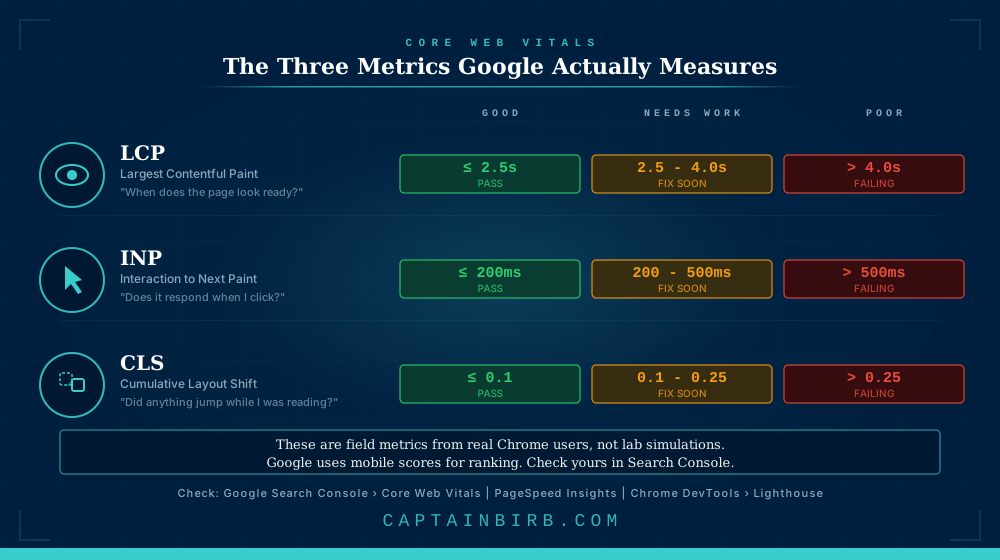
| Metric | What it measures | Good threshold |
|---|---|---|
| LCP (Largest Contentful Paint) | How long until the main content is visible | Under 2.5 seconds |
| INP (Interaction to Next Paint) | How long the page takes to respond when someone clicks, taps, or types | Under 200 milliseconds |
| CLS (Cumulative Layout Shift) | How much the page layout jumps around while loading | Under 0.1 |
LCP answers “when does the page look ready?” INP answers “when I click something, does it respond?” CLS answers “did anything move after I started reading?” Together, they capture the three things that make a page feel broken or feel solid.
INP replaced the older FID (First Input Delay) metric in March 2024. If you see references to FID in older guides, they are outdated.
Why It Matters for Your WordPress Site
Google confirmed in 2021 that Core Web Vitals are a ranking signal. Not the only one, not even the most important one, but a real factor that can tip the balance between two otherwise comparable pages. For competitive queries, the margin matters.
More practically: poor Core Web Vitals correlate directly with higher bounce rates and lower conversions. A page that takes four seconds to show content loses roughly half its visitors before they see anything. A page where buttons don’t respond for 400ms feels broken even if it technically works. A layout that shifts while someone is about to tap a link sends them to the wrong destination.
For WordPress specifically, the usual culprits are unoptimised images (LCP), heavy JavaScript from page builders or analytics scripts (INP), and ads or embeds that load without reserved space (CLS).
What Most People Get Wrong
The first misconception is that Core Web Vitals are a speed test. They are not. PageSpeed Insights gives you a score from 0-100, but that score is a synthetic lab test. Core Web Vitals are field data from real users on real devices. You can score 95 on PageSpeed and still fail Core Web Vitals if your actual visitors are on slow connections.
The second misconception is that installing a caching plugin fixes everything. Caching helps LCP by serving pages faster, but it does nothing for INP (which depends on JavaScript execution) and nothing for CLS (which depends on how your layout is structured). The three metrics require three different kinds of attention.
The third: chasing perfect scores. Google’s thresholds are pass/fail: good, needs improvement, or poor. Getting LCP from 2.4s to 1.8s is meaningful. Getting it from 1.2s to 0.9s makes no measurable difference to rankings or user experience. Fix what is broken; do not polish what already works.
| What people assume | What is actually true |
|---|---|
| PageSpeed score = Core Web Vitals | PageSpeed is a lab simulation; CWV is field data from real users |
| Caching plugin solves all three metrics | Caching helps LCP but does nothing for INP or CLS |
| Perfect scores are necessary | Pass the “good” threshold; improvements beyond that have diminishing returns |
| Mobile and desktop scores are the same | Google uses mobile CWV for ranking; your desktop score is informational |
The CaptainBirb Take
Core Web Vitals are one of the few areas where Google tells you exactly what they measure, exactly what thresholds they use, and exactly where to check your numbers. There is no ambiguity. For any WordPress site that depends on search traffic, passing all three metrics on mobile is baseline hygiene: start with a competent managed host (server response time drives LCP), use properly sized images with defined dimensions (LCP and CLS), and audit your JavaScript load (INP). Check your numbers in Google Search Console under the Core Web Vitals report quarterly. Fix what is flagged. Move on.